Prospect tells Parliamentary committee that nuclear decommissioning is not sufficiently valued
Sue Ferns OBE, Prospect’s Senior Deputy General Secretary, told a Commons committee that nuclear decommissioning is not sufficiently valued, despite the fact that the decommissioning mission is essential for a vibrant new build sector.
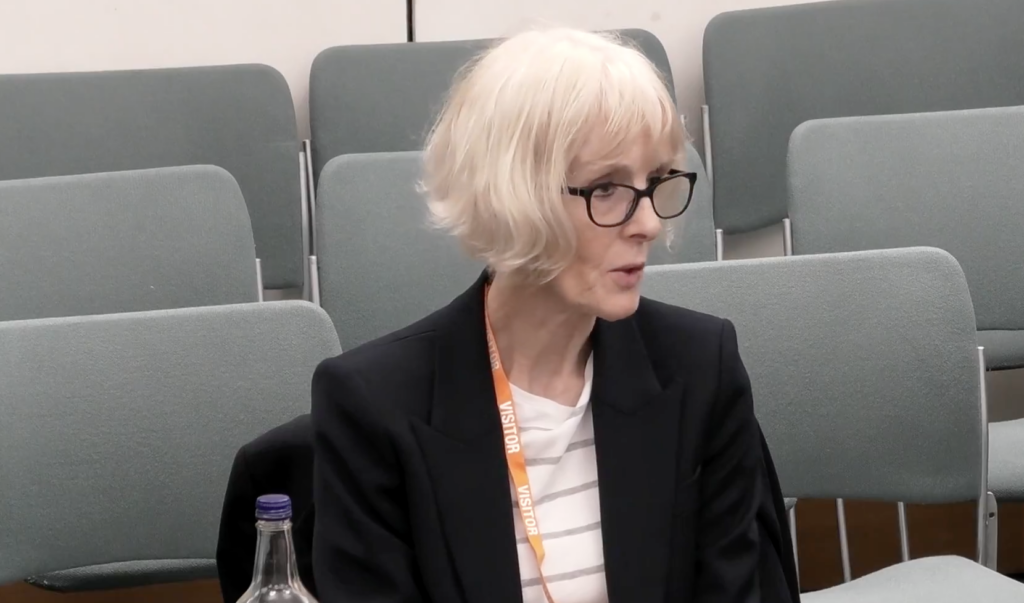
Sue Ferns OBE speaking to the Energy Security and Net Zero Committee
The remarks came during an oral evidence session held by the House of Commons Energy Security and Net Zero Committee on Wednesday, 25 February as part of its inquiry on revisiting the nuclear roadmap. The session focussed on the nuclear workforce and skills, and can be viewed in its entirety on Parliament TV.
On nuclear decommissioning
“Across the Nuclear Decommissioning Authority they’re in the process of downsizing jobs by 1,200 or so. I have asked, and I don’t think there’s any monitoring or checks about what skills are being lost as a result of that,” said Sue.
“Completing the decommissioning mission is essential for a vibrant new build sector. I don’t think we say that enough. I don’t think we value the decommissioning mission sufficiently and in our current experience, neither do we value the decommissioning workforce sufficiently.”
Commitments needed from the government
“Some good measures have already been taken with the final investment decision on Sizewell C and the decision to invest in SMRs, but I think we are still lacking certainty. We have got a nuclear road map, but it doesn’t tell us exactly what we need, how it’s going to be built, and who might build it. The mood music is positive, but what we need is greater certainty about what the delivery programme is.
“For example, around Hinkley Point C, where there’s greater certainty, you get the skills development, you get the commitment from younger people to the industry and they know they can get good local jobs. But that’s not evident everywhere. There’s still a lot of pieces to be put into the jigsaw as far as we’re concerned.”
Strenghening the nuclear skills pipeline
“The Nuclear Skills Plan is a welcome contribution… but if we’re going to meet those targets, it means looking at people who are not currently in the nuclear workforce. It means attracting people in who can’t meet the academic requirements for apprenticeships and it means thinking about the energy transition. Have we got a proper strategy to ensure that people moving from other sectors can move into nuclear?
“I don’t think there’s a joined-up programme and I think there’s a lot that the private sector can do. But given the level of government investment in this sector, I think there’s probably more leverage that government could apply in terms of training requirements when it is providing funding for new projects.”
On international competition for skilled workers
“We have seen, for example, people transitioning out of oil and gas, who’ve chosen to take their skills overseas because it’s more beneficial for them to do that. So I to think we have to be very careful about competition for skills.
There will always be market competition in terms of salary, but I think we need to look more holistically about what nuclear is offering to people and primarily it has to be about the certainty of their career, and the ability to get on in the sector.”
On private sector investment on skills
“The government is spending a lot of public money. I think it’s perfectly reasonable for it to have expectations in terms of investment not just in the plan but in the skills as well. Who gives something for nothing? Nobody does. It’s in in our national interest for government to set expectations. For example, a percentage of work forces that are on apprenticeships, the quality of jobs being created, or the contribution to social value.
“I don’t think there are perfect instruments to do this at the moment, but I think we have the foundation. I know the government is looking separately at public procurement and what the strategy might be for public procurement.
“There are various opportunities make sure that, if we have a road map, which provides the long-term certainty that the private companies who are going to invest in it, but also benefit from it, give back their fair share to the workforce, to the skills, and to the community.
“In a different sector in offshore wind, we have as trade unions, just been involved in discussions with the employers in that sector and government about a Fair Work Charter, whereby the employers give commitments on certain standards of employment and creation of good opportunities for people. So, I think there’s an opportunity for initiatives like that to be rolled out more widely as well.”
