Emergency motion calls for investment in skills to help deliver net zero
Greater investment in skills and an alignment of pay and benefits to match the best across energy network operators was the subject of an emergency motion that was passed unanimously by National Conference.
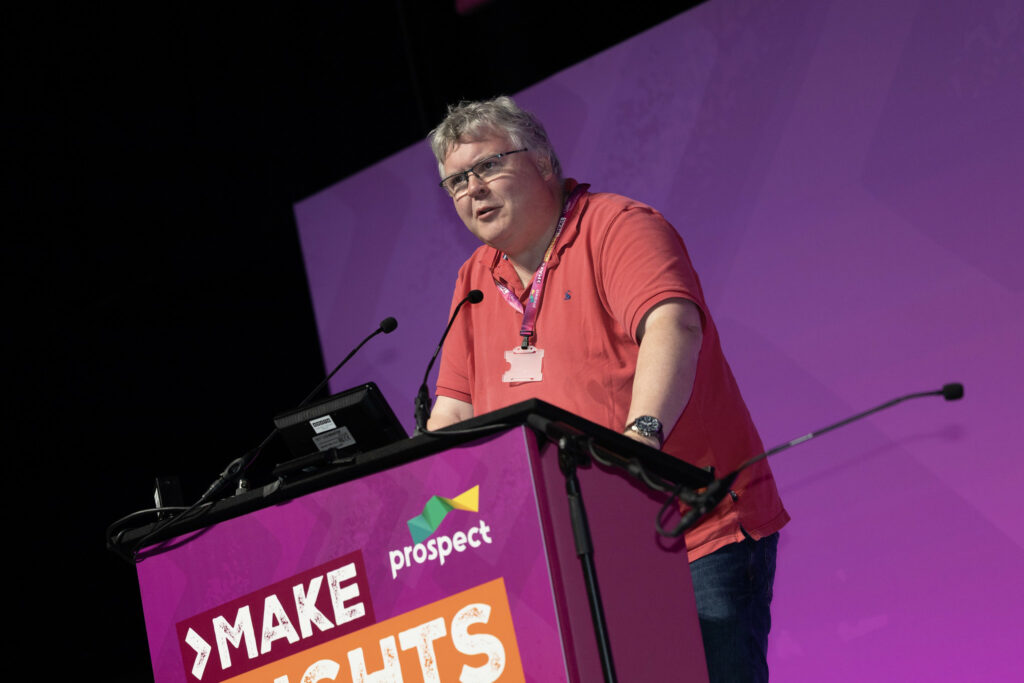
Neil Thomson
The motion “instructs the National Executive Committee to campaign for increased investment in skills and for greater alignment in pay and benefits to the standards of the best across the Distribution Network Operators (DNOs) as part of the UK’s drive towards Net Zero.”
Distribution Network Operators are the energy companies that owns, operates, and maintains the physical infrastructure, such as underground cables, overhead lines, and substations, that delivers electricity from the grid into our homes and businesses.
Moving the motion on behalf of Scottish and Southern Energy Branch, Neil Thomson, said:
“Electricity is a fundamental requirement for modern society. We all know the severe consequences when its supply is interrupted, both on a domestic and national level… Along with the increased demand for electricity comes a need for significant investment in the network.
“Increased resilience in electricity networks can only be delivered by a skilled workforce and by an industry with the ability to attract and retain that skilled staff. Prospect recently conducted a survey of pay rates across the industry, and we found a wide disparity that has developed over recent years between companies. It comes as no surprise that two of the worst-performing employers were also the lowest-paying.
“With this motion, we are calling on the NEC to campaign for increased investment in skills and for greater alignment in pay and benefits to the standard of the best across the DNOs — all as part of the UK’s drive to net zero.”
Speaking to support the motion, Henry Kitchen (Northern Powergrid) said:
Henry Kitchen
“Prospect members in DNOs face the mammoth task of operating, maintaining, and extending crumbling electricity networks. Prolonged underinvestment in networks and staff has been felt across the UK’s electricity industry since privatisation in the early ’90s.
“The challenges we face in keeping the power on safely during increasingly extreme weather events, while attempting to facilitate a just transition to net zero with an exhausted skeleton staff, mean we are under more strain than ever.
“We are losing staff to retirement and burnout faster than we can train them. The huge variance in pay, benefits, and owners’ attitudes between DNOs means that some regions of the UK are disproportionately unable to recruit and retain staff. We are severely affected in my region by this, and it is terrifying. It cannot continue unchecked.”
This was introduced to National Conference as an emergency motion because of the ‘Well Adapted UK’ report by the Committee on Climate change in late May, which warned of the catastrophic effects of climate change across the UK.
Rebecca Downing (National Grid Electricity Distribution) made reference to the report when she spoke in support of the motion.
Rebecca Downing
“The publication of the ‘Well-Adapted UK’ report should serve as a stark warning to all of us. The impacts of climate change are no longer distant predictions; they are already being felt across our communities, our infrastructure, and our workplaces.
“If the UK is serious about achieving net zero while maintaining energy security, then investment in our electricity networks is not optional — it’s essential.”
No-one spoke against the motion, which was carried with all 279 delegates voting in favour, and none against.
