Industry leaders reveal how they are working towards a just transition at Prospect National Conference fringe event
How to ensure that the energy transition from fossil fuels to renewables will benefit local communities and create good quality jobs, commonly referred as a just transition, was the subject of a lively fringe session at Prospect’s National Conference in Brighton on Sunday, 7 June.
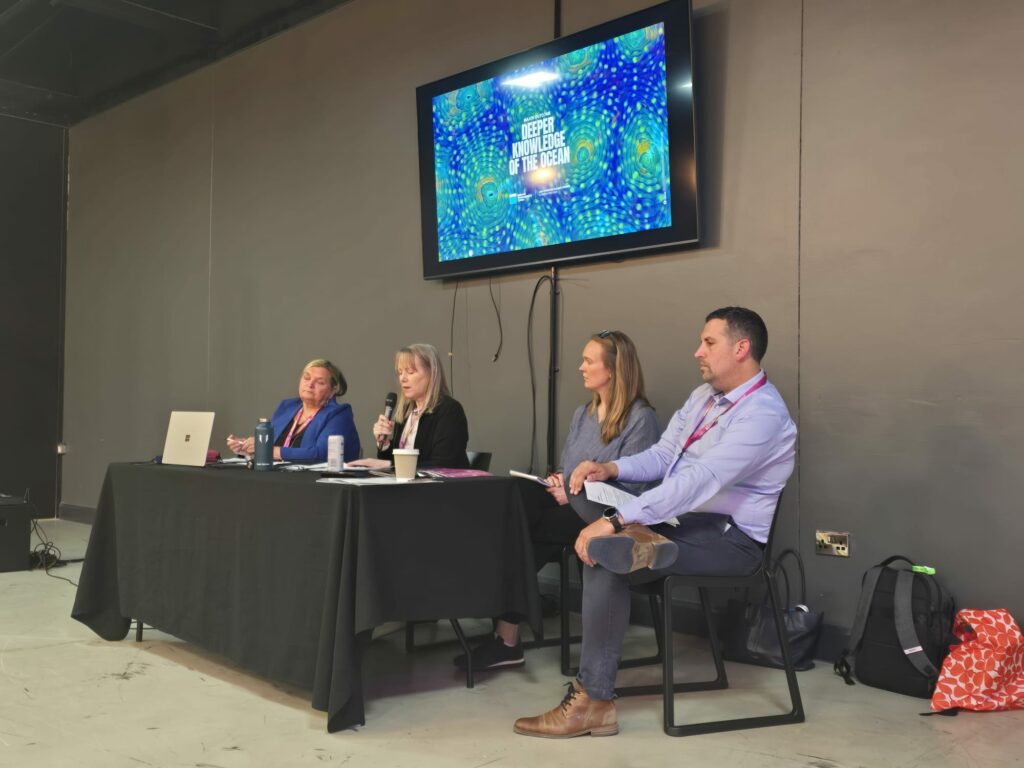
Left to right, Audrey Uppington, Professor Penny Holliday, Charlotte Hall and Scott Young
Chairing the session, Audrey Uppington, Prospect Sellafield rep, said in her opening remarks:
“Evidence of the climate crisis is undeniable. Policies and actions to decarbonise the economy are clearly lacking, with the workers most directly affected often being overlooked.
“Unions have a key role to play in demonstrating the value of scientific data and that a better future is possible based on good quality, unionised jobs. Prospect, with the GMB union, created Climate Jobs UK about a year ago for precisely this purpose.”
The speakers on the panel were:
- Professor Penny Holliday, National Oceanography Centre
- Charlotte Hall, Executive Director, Climate Jobs UK
- Scott Young, Director of Renewable Delivery, Renewable UK
Here are the introductory talks made by each speaker before the session was opened for questions from delegates.
The transcripts have been edited for length and clarity.
Professor Penny Holliday, National Oceanography Centre
I come to this discussion as an experienced physical oceanographer and as somebody with responsibility for a large and diverse scientific workforce. As the Chief Scientist at the National Oceanography Centre, NOC for short, I support hundreds of scientists, engineers, and specialists working in the field of marine science.
Our core aim is simple but ambitious: to help every living thing on our planet to flourish.
That’s a big statement, but it underpins everything that we do because our aim is all about gaining deeper knowledge of the ocean and then applying that knowledge to some of the most urgent environmental and societal challenges of our time.
These include climate change, but also biodiversity loss, sea-level rise, and the future of ocean-based economies.
The important thing I’d like everyone to take away from today is that the ocean affects all of us. Whether we live on the coast, or hundreds of miles from the land: everything we do is regulated by our climate.
At NOC, our research spans the entire ocean environment from the coast to the deep sea, and we work on a whole range of topics to provide that knowledge that people need to understand how the ocean affects them.
Of course, we don’t do this work in isolation. We work closely with partners across the UK and internationally. Ocean research is very much an international, collaborative effort.
At NOC we are increasingly focused on ensuring that scientific innovation translates into wide economic and societal benefits.
We have something called NOC Innovations, which is a commercial subsidiary through which we build partnerships between world-leading ocean research and the commercial sector to help sustain the marine economy regionally, nationally, and internationally.
That helps to stimulate productivity, growth, job creation, and innovation in the marine technology sector. So, we’re not just about science, we’re also about the technology that enables it.
Everything I’ve said about the National Oceanography Centre is really made possible by our people. We employ 765 people across our sites in Southampton and Liverpool, as well as on board two royal research vessels, which we operate on behalf of the government.
We’re proud of the strength and the stability of our workforce. We have very high retention and, something that’s very close to my heart, female representation within our workforce, which historically has been rather low, is growing steadily over recent years.
We also recognise the important role that trade unions play in representing our workforce. Prospect, PCS, RMT and Nautilus International are all recognised unions representing different groups of colleagues across the organisation.
Here’s an example to support my argument that the transition to a more sustainable future, at the heart of which, is also recognising the value of these skilled jobs and the people who do them.
On Blue Carbon, we undertake a lot of research into coastal and marine ecosystems such as salt marshes, seagrass meadows, mangroves, mudflats, and seabed habitats, both in the UK but also internationally.
These ecosystems play an important role in capturing and storing carbon, helping to get it out of the atmosphere and helping them to contribute to climate change mitigation. Our research is all about understanding how these habitats function, how much carbon they can store, and how actions, such as habitat restoration and marine spatial planning, can help them remain healthy and resilient into the future.
The jobs that support climate research are highly skilled and highly specialised. They are essential. They inform policy decisions, enable sustainable economic development, and contribute to the transition towards a cleaner and more resilient future.
So, as we discuss what a just transition should look like, it’s important that environmental research and science are recognised as a core part of that conversation.
Charlotte Hall, Executive Director of Climate Jobs UK
Workers are often hit first and worst by the climate crisis. I really applaud the members of this union fighting that, and I think Prospect has come together with GMB to create Climate Jobs UK with a mission of putting forward a jobs-first approach to the climate challenge we have today.
This country has an ambitious plan to deliver on targets to reduce emissions in line with net zero. Prospect, through Climate Jobs UK and the other roles it plays, is committed to making sure we can deliver that.
I think part of that is by admitting that, in some ways, climate politics is broken. Part of what we want to do at Climate Jobs UK is help make sure that the promise of good clean energy sector jobs is actually delivered — that we’re able to be on the ground to say, “Okay, these are the promises around the jobs and the job quality; is that happening, and how can we make sure that unions are in the workplaces starting with the build?”
One of the critical things about the partnership that Prospect has formed with GMB is that much of the construction worker sector, that’s building clean energy sites for the clean transition, are GMB members.
If we can start from shovels in the ground to make sure that job quality is high on energy build sites, we’re going to be in a much stronger position to make sure that the operation of these sites also is delivering high-quality jobs.
We also want to start not just from shovels in the ground but, especially in the energy sector, looking at sites that we know will be decommissioned.
I want to acknowledge the critical importance of the many scientists who are out there producing the science and technology we need to make this transition. And another really strong aspect about the partnership to create Climate Jobs UK is that it recognises that the workplace protections of climate scientists are just as critical as the protections of construction workers at the build sites.
I’m originally from the US and I look across the pond: climate scientists have just had their civil service classification stripped away because they want to control the story. We cannot let something like that happen here.
Scott Young, Director of Renewable Delivery, Renewable UK
We represent about 500 or so renewable power generators, supply chain companies through to consultants, HR specialists, and legal entities operating in the renewable generation space. We’re a trade association representing those voices to government.
We’ve spoken quite a bit about climate change, and within that context, the renewable energy sector that we have here in the UK is a hugely important national asset.
At a time of global uncertainty and volatility, that asset really strengthens our, and secures our electrical supply, protects bill payers from the volatility of global price shocks and is powering a new era of British industry.
But, I thought it might be worth going back 25 years or so to the turn of the century and reflecting on where renewables were at that point and where we are now.
In around 2000, wind power was supplying about 1% or less of UK electricity, and offshore wind existed only as a two-turbine demonstration project. Coal and gas supplied over 70% of UK electricity.
Compared to a position today where, I checked before coming in here, at 10am this morning, renewables were supplying about 83% of demand. That’s 50% from wind, 20% from solar, and less than 10% coming from gas.
The offshore wind farm at Hornsea 2, which is the world’s biggest wind farm, one rotation of the blades on each turbine, generates enough electricity to power a home for a whole day.
Essentially, renewables have gone from being a bit of a niche sector to something that is now core infrastructure.
I guess, from an industry perspective, that brings fundamentally new challenges: a rapid scale-up of employment, a huge ramping up of the supply chain in particular but along with all that comes real increased worker and public scrutiny of our sector.
Our role in representing industry is not just about the deployment and growth of renewables but shaping the conversation around how that growth happens.
To that end, we’re looking at a couple of things. One, how we build supply chain capacity and capability?
Secondly, the work that we do around work standards, skills, and employment practices.
On the supply chain, we’re absolutely committed to growing that here in UK: for UK suppliers to provide more components, manufacturing, and services that we need to build renewable power.
Each large offshore wind farm adds about £2-3bn to the economy, and there’s something like 2,000 supply chain companies across the UK.
We want to do more, and to that end, Great British Energy, the Crown Estate, and the supply chain industry have come together to support an industrial growth plan which amounts to about a billion pounds worth of new funding to grow UK suppliers in five technology areas where we have real capability and potential for future capacity.
Then, on workforce and skills, we’ve set new apprenticeship targets, created a commitment to greater diversity and we’ve led the delivery of the energy skills passport, which is focused on helping those workers from oil and gas transition into renewables.
In fact, a couple of years ago, we set up our trade union forum, which I’m delighted to say that Prospect and the GMB are both part of. We look at shared areas that we can work on jointly as industry and trade unions.
So we’ve, for instance, commissioned reports on employment standards, and that’s just come back with some interesting findings showing that the sector does really good work on direct employment, on EDI, and on health and safety standards, but there’s more to do around pay transparency and in other areas too.
We’ve also been leading the negotiation on the Fair Work Charter on behalf of industry sitting across the table, I guess, from the six trade unions that were on the other side of that conversation.
In terms of what the Fair Work Charter covers, it is very much anchored in the government’s Clean Energy Jobs Plan, it’s aligned with the Employment Rights Act, and it will enshrine sector-wide commitments to high-quality employment. Specifically, it focuses on independent worker voice.
Last week, the government announced that there were 37 suppliers that had signed up to the charter. Those signatories will work with trade unions around voluntary access agreements, providing workers with information about their rights to join trade unions, and see early implementation of a lot of the provisions that come into place through the ERA legislation later this year.
There are also provisions on health and safety, welfare and a number of escalation processes that could see, in the worst-case scenario, businesses struck off and unable to apply for future funding should they not uphold their end of the bargain.
